Waking up to find your YouTube channel gone is a creator's worst nightmare. It's a gut-punch that instantly severs the connection to your audience, your income, and the brand you've worked so hard to build. This digital eviction often feels abrupt and bewildering, but the first step toward getting your channel back is understanding this new reality of platform enforcement.
The New Reality: What a YouTube Ban Actually Means
When your channel vanishes, it's not just a glitch. It’s a total disruption of your online presence. That initial wave of panic is understandable, but it's your biggest enemy right now. The key is to push past the shock and start a calm, methodical process to figure out what happened and how to respond.
A YouTube ban isn't some random act. It's the outcome of a massive, complex system that uses both automated bots and human reviewers to police an unimaginable amount of content. And because of that scale, mistakes are inevitable. Your ban could be a legitimate penalty for a rule you didn't realize you were breaking, or you could simply be collateral damage in a wide-ranging enforcement sweep.
Strikes vs. Terminations: Know What You're Dealing With
Before you do anything else, you absolutely must identify the specific penalty your channel received. The path to recovery is completely different for each, and confusing them will get you nowhere.
Community Guideline Strikes: Think of these as warnings. One strike is a slap on the wrist, usually limiting features like live streaming for a week. But get three strikes within a 90-day period, and your channel is terminated. Simple as that.
Copyright Takedowns: These are a different beast entirely. They live in the world of intellectual property law and are handled through a separate legal process. While accumulating too many can also lead to termination, they aren't the same as guideline strikes.
Full Channel Termination: This is the nuclear option. Your entire channel—every video, comment, and subscriber—is wiped from the platform. Critically, you are also banned from creating, owning, or even using any other YouTube channels.
We're in an Era of Mass Enforcement
YouTube has ramped up its moderation efforts to an incredible degree, and we're now seeing large-scale purges of channels. These sweeps are usually designed to target a specific type of violation, like spam or deceptive practices, but their automated nature means innocent creators often get caught in the dragnet. This is the precarious reality of building a business on someone else's platform.
For instance, in 2025, YouTube launched a massive purge, terminating a jaw-dropping 12 million channels in just nine months. Q3 alone saw 7.4 million channels deleted in a crackdown on mass-produced AI content, spam networks, and scam operations. But plenty of legitimate creators got caught in the crossfire, which just goes to show how easy it is to lose everything over a single perceived misstep. You can dig deeper into these numbers in YouTube's official enforcement reports.
"A YouTube termination isn't just losing a channel. It's losing your digital real estate, the community you built, and a huge piece of your brand's identity. Your recovery plan has to be as serious as the penalty."
That first 24 hours is a critical window where the actions you take can make or break your chances of a successful appeal. To help you focus, here's a quick-glance checklist of what to do immediately.
Your First 24 Hours After a YouTube Ban
Immediate Action | Why It Is Critical | Tool or Resource Needed |
|---|---|---|
Check Your Email (All Folders) | The termination notice contains the specific reason for the ban. This is the foundation of your entire appeal. Don't overlook the spam folder. | Your associated Google Account inbox. |
Read the Stated Policy Violation | Don't just skim it. Go to YouTube's policy page and read the rule you allegedly broke, word for word. Understand their definition. | |
Do NOT Create a New Channel | This is a direct violation of the termination terms and will get any new channel instantly banned. It also severely hurts your appeal chances. | Self-control. |
Secure Your Other Social Accounts | Update passwords and enable 2FA everywhere. If your Google account was compromised, your other platforms could be next. | |
Draft a "Holding Statement" | Prepare a brief, professional message for your other platforms (Twitter, Instagram, etc.). Acknowledge the situation without blaming or panicking. | Your other social media accounts. |
Staying calm and methodical in that first day sets the stage for everything that follows.
Understanding this environment isn't about scaring you—it's about preparing you. When you know that even well-meaning creators can get flagged by an algorithm, you can approach the situation with the right mindset. This isn't the time for an emotional rant; it's the time for a clear, evidence-based strategy to prove your case. And that’s exactly what this guide will walk you through.
Diagnosing the Reason for Your Channel Takedown
Getting that termination email feels like a punch to the gut. The natural reaction is to panic and fire off a desperate, generic appeal, but that’s the single biggest mistake you can make. It’s a fast track to a permanent "no."
To have any hope of getting your channel back, you need to switch gears from creator to detective. Your first job is to figure out exactly why you were shut down. This means moving past the initial shock and getting into a forensic mindset.
Your investigation starts with the most critical piece of evidence: the termination email from YouTube. Don't just skim it. Buried in the corporate jargon is the specific policy they claim you violated. Find that policy name, pull up the official YouTube Community Guidelines, and read the entire section—word for word, several times. You have to understand their definition, not just your interpretation of it.
For instance, getting a notice for “spam, deceptive practices, and scams” is incredibly vague and frustrating. This is a massive catch-all category that can mean anything from misleading thumbnails to using a questionable link shortener in your video descriptions. A successful appeal depends on you connecting that broad policy to a specific action you took.
Conducting a Forensic Channel Audit
Once you know the alleged violation, it’s time to put your own channel under the microscope. This is tough. You have to step back and look at your content the way a stranger—or a strict YouTube reviewer—would. The goal is to pinpoint the exact video, description, tag, or link that likely set off the alarms.
Start with your last 5-10 uploads and scrutinize every single element:
Titles & Thumbnails: Did you get a little too clickbaity? Does a thumbnail promise something the video doesn't deliver?
Descriptions & Tags: Did you "tag stuff" by loading up the description with irrelevant keywords just to rank higher? Are all of your links clean and pointing to reputable sites?
Video Content: Watch the videos again. Is there a single moment, even a few seconds, that could be misinterpreted? Think about everything—the audio, what's on screen, and any text overlays.
This flowchart gives you a good idea of how YouTube’s enforcement ladder works, from simple warnings to a full-blown termination.
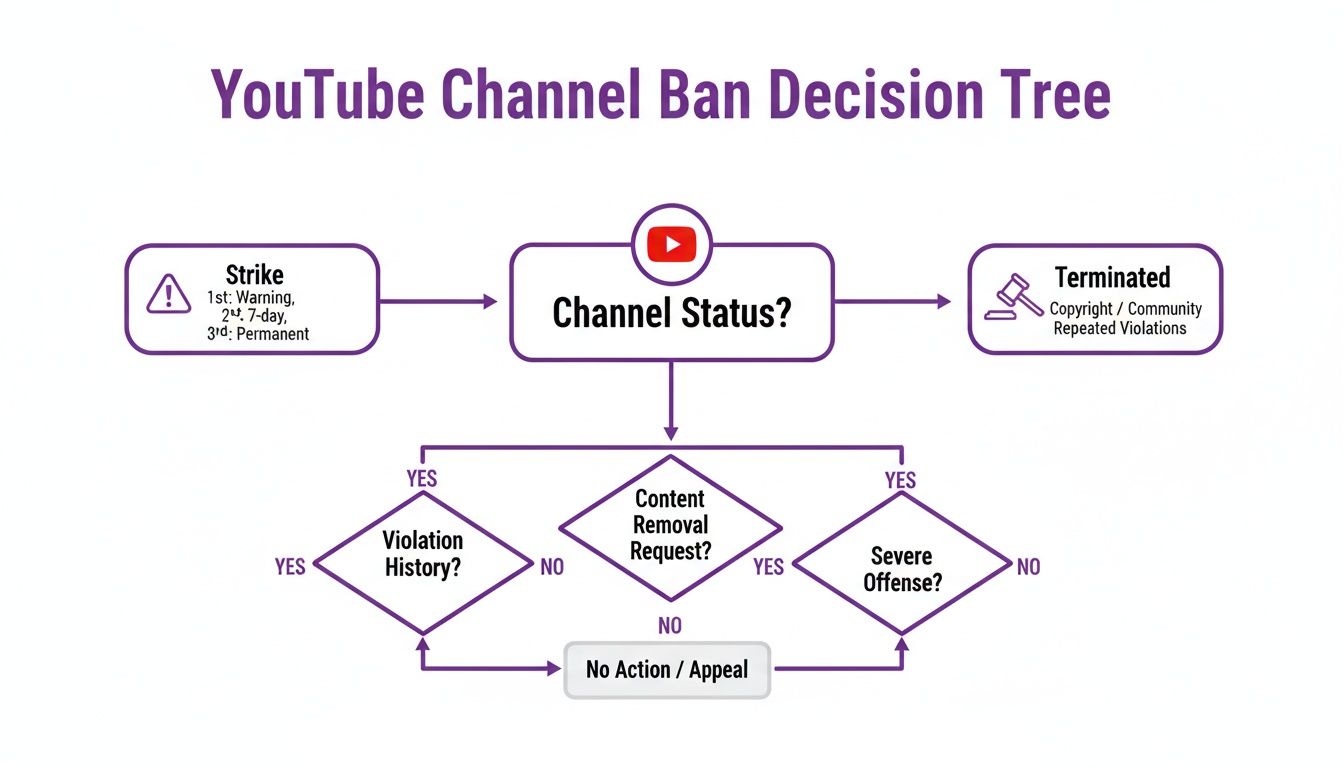
As you can see, while a single strike might just put you in a temporary time-out, a severe violation or stacking up too many offenses can get you banned immediately, skipping all the warnings.
AI Flag vs. Human Review: What's the Difference?
Knowing who made the call—a bot or a person—is a huge piece of the puzzle. The timing of the takedown often gives it away.
Did your channel get terminated just minutes after you uploaded something new? That’s almost certainly an automated AI flag. The good news is that these systems are built for speed, not nuance, so they make mistakes. It’s often easier to appeal an AI decision because you can argue that the bot simply misunderstood the context of your content.
But if the ban came down after a user reported your content or your channel was flagged for manual review, you’re dealing with a human decision. This is a much harder battle. A person has already looked at your content and decided it was a violation. To win this appeal, you need to bring new information or context to the table that they might have completely missed the first time around.
I’ve seen countless channels get torpedoed by something they did years ago. A common culprit is affiliate marketing. While it's allowed, YouTube is extremely strict about cloaked or shortened links, especially if they point to sites it deems spammy. One bad link in the description of a video from 2018 can absolutely get your entire channel terminated today.
Let's look at a real-world scenario. A gaming channel gets flagged by the AI for “violent or graphic content” because the bot can’t tell the difference between a video game and real-life violence. The appeal here is straightforward: explain that the content is clearly marked as gaming, which falls within YouTube's own policies.
Now consider a finance creator who was manually reviewed and terminated for promoting “harmful or dangerous acts” after they featured an unregulated crypto platform. That’s a much steeper hill to climb. Their appeal would have to prove they did extensive due diligence and that the platform was legitimate—a far more complex argument to make.
Nailing down the specific video and the likely trigger gives you the ammunition you need for a targeted, evidence-based appeal. Without this diagnosis, you're just yelling into the void, and your chances of reversing the ban are slim to none.
Crafting an Appeal That Gets a Human Review
When your YouTube channel disappears overnight, the first impulse is usually a mix of panic and anger. It’s natural to want to fire off a frustrated message, but that's the fastest way to get your case shut down for good.
The key to a successful appeal is to switch gears entirely. Forget venting. Your one and only goal is to present a calm, logical, and professional case that persuades a human reviewer to take a second look.
Think of it less like a complaint and more like a concise legal brief. A rambling, emotional email is easy for a busy reviewer to dismiss. A well-structured, fact-based argument that respects their time is much harder to ignore.
The Anatomy of a Winning Appeal
From what I’ve seen, every successful appeal follows a simple, three-part structure. Sticking to this framework keeps your message clear and drastically improves your odds.
Remember, the person reading your appeal is likely dealing with hundreds of similar cases. Make their job easy by giving them exactly what they need, right up front.
Your appeal needs to hit these three points in order:
Acknowledge the Violation: Start by naming the specific policy you were flagged for. Use the exact wording from the termination email. This immediately shows you've read the notice and are taking this seriously.
Provide Context or Counter-Evidence: This is where you make your case. Calmly explain why this was a misunderstanding or provide the critical context the automated system missed. No fluff, no emotion—just the facts.
Outline Corrective Action: Finish by stating what you’ve already done to fix the issue and how you'll prevent it from happening again. This shows you’re a responsible creator who wants to follow the rules.
This approach proves you understand the platform's guidelines and deserve another chance.
What to Include and What to Leave Out
The details you provide can absolutely make or break your case. Being strategic here is critical. This isn't the time to tell your channel's life story or list your accomplishments.
Key Information to Always Include
Your Channel URL: This is a must. Without it, the reviewer can’t even find your case to begin with.
The Specific Policy Violation: Quote it word-for-word from your termination notice, like "spam, deceptive practices, and scams."
Links to Specific Videos (If Applicable): If you’ve pinpointed the video that likely caused the ban, provide the direct URL. This helps the reviewer get straight to the problem.
On the flip side, some things will torpedo your appeal instantly. Avoid them at all costs.
Information to Strictly Avoid
Emotional Pleas: Lines like "YouTube is my entire life" or "this is so unfair" won’t help. The review team works based on policy, not sympathy.
Threats or Aggression: Threatening legal action or using aggressive language is a surefire way to get your appeal denied and the door slammed shut permanently.
Blaming the Algorithm: Simply saying "your bot messed up" isn't a valid argument. You have to explain why and how it made a mistake, using specific examples from your content.
"Your appeal is your one shot to make a professional first impression on a human reviewer. Treat it with the seriousness of a business proposal, because for your brand, that's exactly what it is. Logic wins, emotion loses."
Appeal Scenarios and Language to Use
Your approach has to change depending on why you were banned. A simple mistake by the AI requires a different tone than a situation where you accidentally broke a rule you didn't know about.
Let’s walk through two very common scenarios.
Scenario 1: The AI Misinterpreted Your Content
This happens all the time. An algorithm might flag a gaming video for "real-world violence" or an educational video on hacking for "harmful and dangerous content." Your appeal needs to provide the missing context.
Bad Approach: "Your stupid bot flagged my video for violence when it's obviously a game! Fix this now!"
Good Approach: "My channel was terminated for a violation of the 'Violent or Graphic Content' policy. The content flagged is gameplay footage from 'Apex Legends,' which is simulated and a widely accepted content format. The flag appears to be an automated error misinterpreting in-game actions. I have reviewed my content, and it fully complies with platform guidelines."
Scenario 2: You Unintentionally Broke a Rule
Maybe you used a link shortener in old video descriptions that has since been banned. You didn't mean to break the rules, but you did. The best strategy here is to own it and show you've fixed it.
Bad Approach: "I didn't know that link service wasn't allowed. How was I supposed to know? You can't just ban me for an old mistake."
Good Approach: "My channel was terminated under the 'Spam, Deceptive Practices, and Scams' policy. After auditing my content, I found that several older videos used a URL shortener that I now understand is not permitted. I was unaware of this rule but accept full responsibility. I have since removed all non-compliant links and will only use approved methods moving forward."
This professional, evidence-based approach is your best—and really, your only—shot at getting a human to take you seriously and give you back your channel.
Don't Go Dark: Keeping Your Brand Alive During a Ban
When your YouTube channel vanishes overnight, it leaves a gaping hole where your brand used to be. The shock is real, but letting your brand's voice disappear along with your videos is a critical mistake. If you go completely silent, your audience will be left confused, unable to find you, and will likely assume the worst. The trick is to get out in front of the narrative immediately and maintain a sense of continuity, even when your main stage is gone.
This isn't the moment for a long, emotional post. Your first communication needs to be calm, professional, and reassuring. Jump onto your other platforms—X, Instagram Stories, your email newsletter—and post a single, unified message. Acknowledge what happened, but don't get into a blame game or start speculating.
Crafting Your Public Statement
Keep your initial holding statement short and to the point. The goal here is simple: inform your audience, manage their expectations, and tell them where to go for updates. If you panic, your community will panic right along with you.
A solid first message is straightforward:
Acknowledge: "We're aware our YouTube channel is currently unavailable."
Action: "We're looking into it and are in touch with YouTube to get this sorted out."
Reassurance: "All our other platforms and services are running as usual. Thanks for your patience and support."
This approach stops rumors before they start and shows your audience you're still in control, even when things have gone sideways. It projects stability in the middle of chaos.
A brand’s character is defined by how it handles a crisis. When you're banned from YouTube, your audience isn't just watching to see if you get the channel back; they're watching to see how you handle the heat. Professionalism now pays off in loyalty later.
The Locked Handle Problem
One of the most infuriating, and often overlooked, side effects of a YouTube ban is what happens to your unique @handle. Once your channel gets the axe, that handle is locked. It's not released back into the wild for someone else to grab, and you can't use it for a new channel. It's just... gone, trapped in a digital limbo.
This frozen handle is a nightmare for brand consistency. If your handle is "@BrandName" on every single platform, a YouTube termination shatters that uniformity overnight. You're left with a tough choice: do you wait it out, hoping your appeal works, or do you rebrand on YouTube with a different handle and fragment your brand identity? This is especially damaging for discoverability and can seriously confuse your audience. If you want to understand just how crucial username consistency is, our guide on how to change your TikTok username and why it matters is a great read.
The fight for good handles is already intense. As of August 2025, only 618,955 channels had even hit 100K subscribers—that's less than 1%—while a staggering 65.3 million creators are all competing for visibility. For brands, a ban means your unique @username is gone, taking all its SEO value with it and forcing a chaotic rebrand. You can dig deeper into these numbers in this detailed analysis of YouTube's creator landscape.
Protecting Your Brand Identity Proactively
This whole scenario drives home one of the oldest lessons in the digital world: never build your empire on rented land. YouTube is a powerhouse, but it should only be one pillar of your brand strategy, not the entire foundation.
To protect your brand from a single point of failure, you need a multi-platform defense. Here’s what that looks like:
Secure Your Handle Everywhere: Before you even launch, go out and claim your desired @handle on every major platform—YouTube, Instagram, X, TikTok, LinkedIn, Facebook. Even if you don't plan on using them all right away, owning the handle prevents squatters and ensures you have a consistent brand identity ready to go if you ever need to pivot.
Build Your Email List from Day One: Your email list is the only audience you will ever truly own. Period. Use your videos and social posts to constantly drive sign-ups. If your channel ever gets wiped, that list is your direct line to your most dedicated followers. You can update them on your appeal, point them to a new channel, or just keep the conversation going.
Establish a Central Hub: Your website is the sun in your brand's solar system. It’s the one place your audience can always find all your content, buy your products, and connect with you, no matter what happens on social media. Every piece of content you create should point back to your site.
By diversifying your presence and owning your audience connection, you make sure a YouTube ban is just a serious setback, not a fatal blow.
Future-Proofing Your Channel to Avoid Another Ban
Look, the absolute best way to handle a YouTube ban is to make sure it never happens again. Getting a channel back is a brutal, uphill fight. But building a resilient, compliant operation from the get-go? That’s a strategy you can actually control.
Future-proofing isn't about finding clever loopholes. It’s about building a content ecosystem so solid that it can weather unexpected policy shifts and the whims of the algorithm. It's time to stop being reactive. Don't wait for a warning strike to land in your inbox—start actively auditing your own channel, staying ahead of policy changes, and locking down your digital turf. A bit of diligence now can save you from a complete catastrophe later.
Build a Habit of Proactive Compliance
I've seen it time and time again: the most common reason creators get into hot water is simple ignorance. YouTube's rules aren't set in stone. They're constantly changing to keep up with new trends, regulations, and whatever new chaos is happening online. What was perfectly fine a year ago might be a channel-killer today.
To stay on the right side of the guidelines, you have to start treating policy updates like essential industry news. And this isn't just for new creators. In fact, established channels are often the most at risk because they’re sitting on a massive backlog of old content that could easily violate a new rule.
Here’s how you stay ahead of the curve:
Monthly Policy Check-ins: Once a month, carve out 15 minutes to skim the official YouTube Community Guidelines. Seriously, put it on your calendar. Look for new sections or updated language, especially in thorny areas like hate speech, child safety, and spam.
Follow the Source: Subscribe to the YouTube Creators channel and keep an eye on their official blog. This is where the big announcements drop first, usually with detailed examples of what not to do.
Audit Your Backlog: Every quarter, do a spot-check on your older videos. Pay close attention to descriptions, tags, and especially your links. A link that pointed to a helpful resource in 2019 might now redirect to a sketchy, spam-filled site, putting your entire channel on the chopping block.
The creators who survive and thrive long-term are the ones who weave compliance into their content strategy, not treat it as a chore. They know the rules of the playground because their business depends on it.
Master Your Metadata and Understand Fair Use
So many bans I’ve seen have nothing to do with the video itself. Instead, they’re triggered by sloppy or deceptive metadata. Your titles, thumbnails, descriptions, and tags are just as much a part of your content as the video file.
Misleading metadata is low-hanging fruit for YouTube's enforcement bots. A clickbait thumbnail that promises something the video doesn't deliver or a description stuffed with irrelevant keywords is a straight-up violation of the "spam, deceptive practices, and scams" policy. Your metadata must always be an honest reflection of your content. Period.
Fair Use is another minefield. It’s a legal concept that can let you use copyrighted material without permission for things like commentary, criticism, or news reporting. But here's the catch: it's a notoriously gray area, and "fair use" is a legal defense, not an automatic right.
A few practical tips to stay safer:
Be Transformative: Your work has to add something new—a new meaning, message, or context. Just re-uploading a movie clip with your logo on it isn't going to cut it.
Use as Little as Possible: Only use the absolute minimum amount of copyrighted material you need to make your point. Don't show a whole episode when a five-second clip will do.
Credit Your Sources: While it won’t legally save you if your use isn't transformative, crediting the original creator is just good practice and can show good faith.
Secure Your Channel From Hijackers
Not every ban is your fault. A scary number of channel terminations happen because an account gets compromised. A hacker gets in, uploads a dozen crypto scam videos while you're asleep, and the channel gets terminated by automated systems before you even know what hit you.
By the time you wake up, your channel is gone. Now you’re stuck trying to prove to a faceless support system that it wasn't you. It’s an absolute nightmare.
Strengthening your account security is non-negotiable.
Enable 2-Step Verification: This is the bare minimum. Use a physical security key (like a YubiKey) or a dedicated authenticator app (Google Authenticator, Authy). SMS verification is better than nothing, but it’s vulnerable to SIM-swapping attacks.
Use a Unique, Strong Password: Create a long, complex password just for your Google account. Don't reuse it anywhere else. Store it in a reputable password manager like 1Password or Bitwarden.
Review App Permissions: Every few months, go through the list of third-party apps that have access to your Google/YouTube account. If you don't recognize something or no longer use it, revoke its access immediately.
Ultimately, protecting your channel is a two-front war: compliance and security. By auditing your content against YouTube's ever-changing rules and locking your account down against hackers, you build a foundation that can actually last. This proactive mindset is what ensures a "banned from YouTube" notification is something that happens to other people, not you.
YouTube Ban FAQs: Your Burning Questions Answered
When your channel gets shut down, your mind is probably racing with a million questions. It’s a stressful, confusing time, and getting straight answers is the first step to figuring out what to do next. Let's tackle some of the most common concerns I hear from creators and brands in this situation.
How Long Does the YouTube Appeal Process Usually Take?
Honestly, this is the hardest part: the waiting. There's no set timeline. I've seen some appeals get a response in 24-48 hours, but it’s far more common for it to take several days or even a couple of weeks. It really depends on how complex your case is and how swamped the review teams are at that moment.
The single most important piece of advice I can give you is this: submit one comprehensive appeal and wait. Don't spam them with follow-ups. That’s a surefire way to get your case flagged and pushed to the back of the line, which is the last thing you want.
Can I Just Make a New Channel if Mine Gets Terminated?
Don't do it. The answer is a hard no. When YouTube terminates your channel, they're not just banning that specific account; they are banning you from the platform. It's written right into their Terms of Service.
Trying to get around a termination by starting a new channel is considered ban evasion. YouTube's systems are incredibly good at sniffing this out, and any new channel you create will be shut down almost immediately. This will only make your original appeal harder.
Your one and only legitimate path back onto the platform is to win the appeal for your original channel.
What Happens to My YouTube Handle if I Get Banned?
Your unique @handle gets locked down. It’s essentially frozen in place. It won't be released for someone else to grab, and you can’t use it to start over. It's just... gone, tied to the terminated account. This can be a massive problem if that handle is central to your brand across other social platforms.
If your appeal works, you get everything back, including your handle. But if the ban is permanent, that handle is lost for good. It's a stark reminder of how a problem on one platform can create a domino effect across your entire brand identity.
Will I Get My Subscribers and Videos Back?
Yes, if your appeal is successful. A reinstatement means a full restoration. Your channel should come back online exactly as you left it—all your videos, subscribers, comments, and playlists will be there.
Now, there's a small wrinkle. In 2025, YouTube started experimenting with a "second chance" program for certain types of older, less serious violations. If you're offered this, you don't get your old channel back. Instead, you're allowed to start a brand new channel from scratch. This means you lose all your old content and your subscriber list. You have to re-upload everything (that's compliant, of course) and start rebuilding your community from zero.
Is It Possible to Sue YouTube Over a Ban?
Technically, yes. Realistically, it’s an uphill battle that’s incredibly expensive, drags on forever, and rarely succeeds. When you signed up for YouTube, you agreed to their Terms of Service, which grants them a huge amount of leeway in deciding what stays on their platform and who gets to use it.
For almost everyone, pouring your time, energy, and resources into crafting a solid, evidence-based appeal is a much smarter move. Save the legal talk for extreme, unusual cases, and only after you’ve spoken with a lawyer who truly understands digital media law.
A locked or lost handle can throw a major wrench in your branding efforts. Handles by Kare Social is a specialized service focused on acquiring and unifying your @usernames across all social platforms, keeping your brand identity secure and consistent. If you're struggling with a username issue, see how we can help at https://handles.karesocial.com.


